
New research on systematic investing. Free, every quarter.
Each paper asks one question that matters for your portfolio, tests it on up to 150 years of data with rules that use only information available at the time, and reports what does not work as clearly as what does.
- 150 yearsof market data where it exists
- Real-time rulesno hindsight, no look-ahead
- Placebo & hold-out testsso luck doesn't pass as skill
- Independently verifiedresults rebuilt by a second analysis
When Bonds Stop Hedging
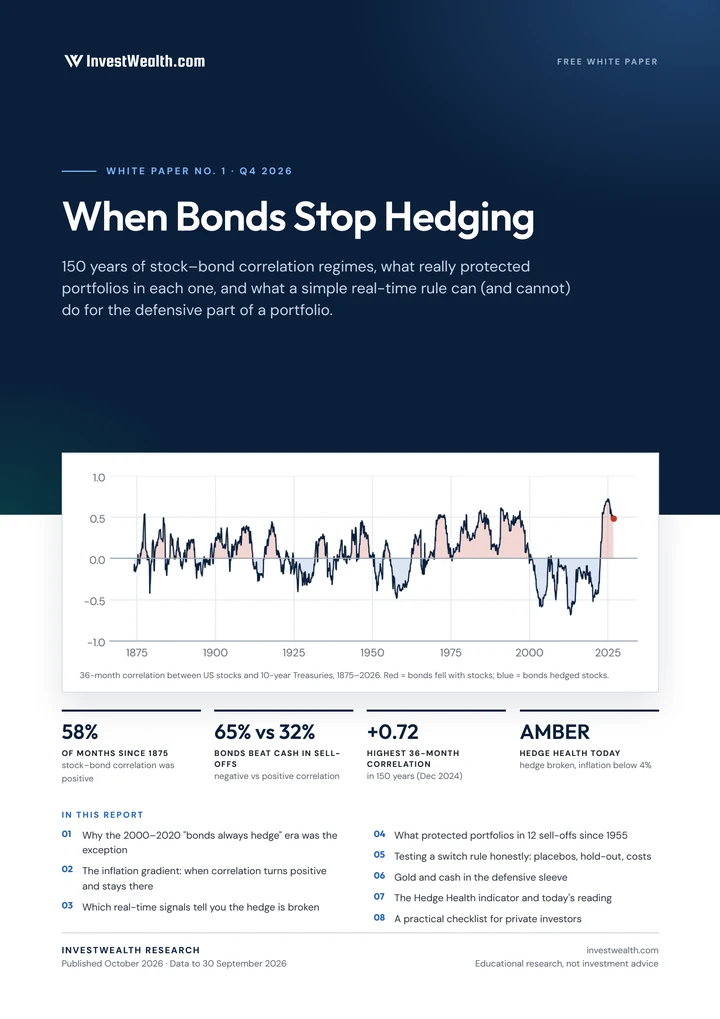
150 years of stock–bond correlation regimes, what really protected portfolios in each one, and what a simple real-time rule can (and cannot) do.
Key findings
- Since 1875 the stock–bond correlation was positive in 58% of months: the 2000–2020 era, when bonds almost always hedged, was the exception
- In stock sell-offs, Treasuries beat cash 65% of the time when the stock–bond correlation was negative, but only 33% when it was positive
- Higher inflation has gone together with a positive correlation since the 1950s — but there is no magic threshold
- Switching bonds to cash helped a little, mostly in 2022–2026; diversifying the defensive sleeve beat timing it
Builds on
Ilmanen (2003), Stock–Bond Correlations, Journal of Fixed Income · Campbell, Pflueger & Viceira (2020), Macroeconomic Drivers of Bond and Equity Risks, Journal of Political Economy · Brixton et al. (2023), A Changing Stock–Bond Correlation, Journal of Portfolio Management · Molenaar et al. (2024), Empirical Evidence on the Stock–Bond Correlation, Financial Analysts Journal · Hurst, Ooi & Pedersen (2017), A Century of Evidence on Trend-Following Investing, Journal of Portfolio Management · Shiller, US stock, dividend, CPI and interest-rate data since 1871 — 22 numbered references in the paper, cited in the text where each claim is made.
The hedge is broken (stocks and bonds move together), but inflation is below the level at which a broken hedge has historically stayed broken.
Coming next
One paper per quarter. Subscribe and we email you each new paper on the day it is published.
Tops and Crashes
Every major market top since 1871: which warning signs were flashing, how early, how many false alarms — and what it cost to act on them.
Builds on: Campbell & Shiller (1998) · Greenwood, Shleifer & You (2019) · Goetzmann (2016) · Sahm (2019)
In researchYour Drawdown Budget
Turn "I can't lose more than 20%" into rules: 150 years of evidence on which simple, unleveraged rule keeps you within budget, and at what cost.
Builds on: Kahneman & Tversky (1979) · Benartzi & Thaler (1995) · Moreira & Muir (2017) · Harvey et al. (2018)
In researchGrowth × Inflation in Real Time
Macro regimes look powerful with hindsight. How much of the edge survives with only the data that was known at the time?
Builds on: Croushore & Stark (2001) · Orphanides (2001) · Hamilton (1989) · Chauvet & Piger (2008)
In researchGet every new white paper
Four papers a year. No spam, unsubscribe anytime.
See the ideas applied to 30 markets, live.
The white papers explain the evidence. The Research Terminal applies systematic strategies to equities, bonds, gold, oil, currencies and crypto every week, with backtests against buy & hold. Free account, no card required.
Open free account See plansHow we research
- One question that matters for private investors, checked against the academic and institutional literature.
- Rules fixed in advance, then tested on the full history with a hold-out period.
- Placebo tests against random timing, and robustness checks on every parameter.
- Independent verification: a second analysis rebuilds the data and the results from the raw files.
- Honest reporting, including the rules that failed and the limits of the data.