
Diversification and correlation
Why owning ten tech stocks is not diversification, how correlation works and how mixing asset classes and strategies smooths returns.
Diversification means spreading your money so that no single loss can sink your portfolio. It is often called the only free lunch in finance — you can reduce risk without necessarily reducing return.
Diversification is about correlation, not count
Ten technology stocks are not ten bets; they are one bet on technology. What matters is correlation — how closely investments move together, from −1 to +1. Combining assets with low or negative correlation is what lowers the swings of the whole portfolio.
Across asset classes
Over the past decade, US stocks, long Treasuries, gold and the US dollar have had low or even negative correlations with each other. A portfolio holding all four has been far smoother than any one of them. You can see the current numbers in our correlation matrix.
| SPY | TLT | GLD | BTC | DBO | UUP | |
|---|---|---|---|---|---|---|
| SPY S&P 500 | 1 | 0.18 | 0.13 | 0.37 | 0.32 | -0.38 |
| TLT US Treasuries 20y+ | 0.18 | 1 | 0.37 | 0.07 | -0.35 | -0.38 |
| GLD Gold | 0.13 | 0.37 | 1 | 0.10 | -0.14 | -0.51 |
| BTC Bitcoin | 0.37 | 0.07 | 0.10 | 1 | 0.11 | -0.14 |
| DBO WTI Crude Oil | 0.32 | -0.35 | -0.14 | 0.11 | 1 | -0.06 |
| UUP US Dollar Index | -0.38 | -0.38 | -0.51 | -0.14 | -0.06 | 1 |
Across strategies
A less obvious source of diversification is the strategy itself. A trend-following strategy that moves to cash when a market falls behaves differently from holding that market. In our research, the 30 trend strategies were much less correlated with each other than the 30 markets behind them — diversification that comes from the process, not just the assets.
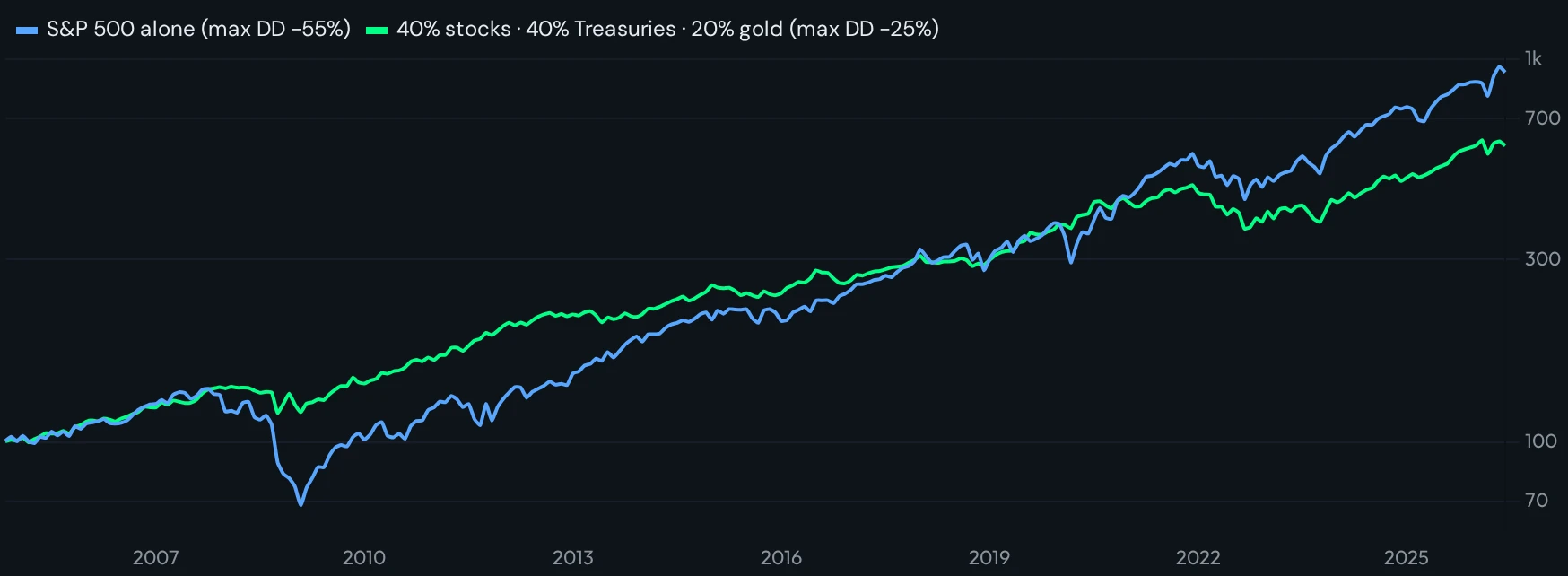
The catch
Correlations are not stable. In sharp sell-offs, many assets fall together, exactly when diversification is needed most. And a diversified portfolio always holds something that is lagging — which tempts investors to abandon it. Discipline matters as much as the mix.
Key takeaways
- Diversify across things that do not move together.
- Mix asset classes and, ideally, strategies.
- Expect correlations to rise in crises.
- Stick with the mix — something will always be lagging.
Check the hedge before you rely on it
- Hedge Health: one reading of whether bonds are protecting stocks
Includes our research emails and offers. Unsubscribe anytime.
Go deeper: in-depth guides
What the stock–bond correlation measures, why it flips between negative and positive, which assets protected a portfolio in each regime since 1955, a…
Bitcoin vs Ethereum vs Solana: returns, volatility and worst falls NEWBitcoin, Ethereum and Solana side by side: return, volatility and every fall of more than 50 %, how all three moved with stocks and gold, and what th…
QQQ vs SPY: Nasdaq-100 vs S&P 500 returns, risk and worst fallsQQQ vs SPY in numbers: QQQ returned 21.9% a year over 10 years, SPY 15.5% (to June 2026), but QQQ fell 83% in 2000–02. Returns by year, risk, fees.
Daily, monthly or yearly compounding, with monthly contributions.
Investment calculator with dividend reinvestmentReinvested vs paid out, plus the real S&P 500 history.
Portfolio Crash TestHow your mix would have held up in every big crash since 1972.
Educational research, not investment advice. Disclaimer.