
The rule of 72: how long does an investment take to double?
The rule of 72 explained: a doubling-time table, how accurate it is, and what inflation, fees and market falls did to it on the real S&P 500 record.
Divide 72 by the yearly return and you get the number of years it takes money to double. That is the whole rule. Since January 1993 the S&P 500 returned 10.7 % a year with dividends reinvested (SPY, after the fund fee, to June 2026). The rule says that means a doubling about every 6.7 years. The record shows about 4.9 doublings in 33.4 years, or one every 6.8 years: almost exactly right. But only if the right return goes into the rule, and only with every crash in between. This guide gives the investment rule of 72 in one line, a full table, how accurate it is, and the three things that slow the doubling clock: losses, inflation and fees.

The rule of 72 in one line, and the other way round
To define the rule of 72 in one sentence: years to double ≈ 72 ÷ yearly return in percent. At 6 % a year that is 12 years, at 9 % it is 8 years, at 12 % it is 6.
The rule also works backwards. Divide 72 by the number of years and you get the return needed to double in that time: doubling in 10 years needs about 7.2 % a year, doubling in 6 years about 12 %.
It only works for growth that compounds, where returns are earned on earlier returns: reinvested dividends (the dividend reinvestment calculator shows that case share by share), interest that is added to the balance, a fund that keeps its gains invested. For interest that does not compound, money grows by the same amount every year and the rule does not apply.
72 is used because it is easy to divide: by 2, 3, 4, 6, 8, 9 and 12.
The rule of 72 table
How close is the quick formula to the exact answer? The exact number of years to double at a return r is ln 2 ÷ ln(1 + r).
| Return per year | Rule of 72 | Exact years to double |
|---|---|---|
| 2 % | 36.0 | 35.0 |
| 4 % | 18.0 | 17.7 |
| 5 % | 14.4 | 14.2 |
| 6 % | 12.0 | 11.9 |
| 7 % | 10.3 | 10.2 |
| 8 % | 9.0 | 9.0 |
| 10 % | 7.2 | 7.3 |
| 12 % | 6.0 | 6.1 |
| 15 % | 4.8 | 5.0 |
| 20 % | 3.6 | 3.8 |
Is the rule of 72 accurate? Between 6 % and 10 % a year it is within about a month. At low returns it overstates the time a little (2 %: 36 years against 35), at high returns it understates it (20 %: 3.6 years against 3.8). For continuous compounding the exact constant would be about 69.3, which is why some people use 70 instead. The cousins: 114 divided by the return gives the years to triple, and 144 the years to quadruple, which is two doublings.
You can see the doubling points for your own numbers in the free compound interest calculator.
*Arithmetic, constant annual return, annual compounding.*
Does it work on real markets? The S&P 500 test
A rule that assumes the same return every year meets a market that never delivers one. So we checked it against the S&P 500 record in our data, measured by SPY, the oldest S&P 500 ETF, with dividends reinvested and after the fund fee. Our S&P 500 historical returns guide has the full record.
- Compound return since January 1993: 10.7 % a year, about 30 times the money by June 2026.
- What the rule says: 72 ÷ 10.7 ≈ 6.7 years per doubling.
- What happened: 30 times is about 4.9 doublings (2 to the power of 4.9 is 30) in 33.4 years, or one doubling every 6.8 years.
The rule passed. Now the trap that most explanations skip. The plain average of the yearly returns from 1994 to 2025 was 12.3 %. Put that into the rule and it promises a doubling every 5.9 years, a whole year faster than what happened. The compound return over exactly the same 32 years was 10.7 %. The difference is what losses do to compounding: a year of −36.8 % (2008) followed by a year of +26.4 % (2009) averages −5.2 %, but the money ended about 20 % below where it started. Only the compound annual growth rate (CAGR) belongs in the rule of 72.
*Past returns do not guarantee future results.*
Why real doublings come in bursts: losses
The rule draws a smooth line. Markets deliver the same result in lumps, and the falls are where the clock stops.
The loss arithmetic is merciless: a fall of 20 % needs a gain of 25 % to get back, a fall of 50 % needs a gain of 100 %. A 50 % fall takes away exactly one full doubling.
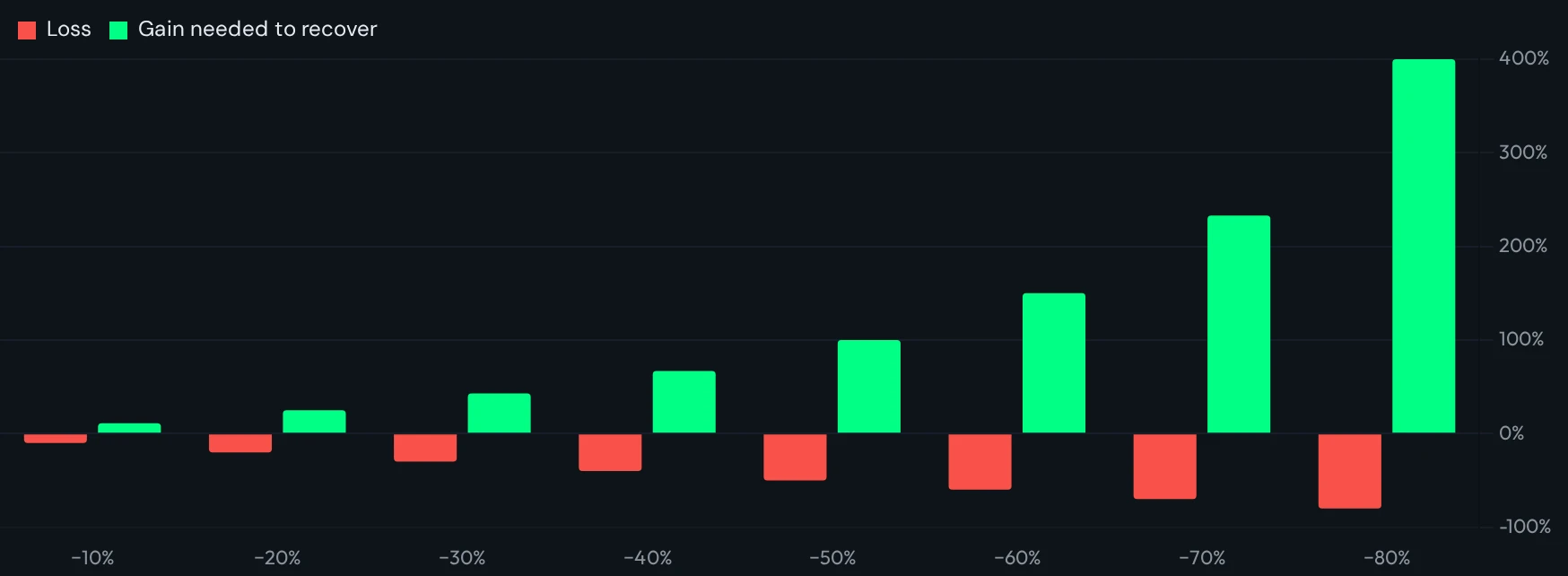
After the October 2007 peak the S&P 500 took almost 5 years, including dividends, to get back to its high. For those five years the doubling clock stood still. Every S&P 500 fall since 1955 was followed by a new high, so the clock restarted each time, but where an investor started, and whether they stayed invested through the fall, decided how many doublings they actually got.
That is also why smaller falls matter for compounding: fewer and shallower falls lose fewer doublings and make a plan easier to keep. Our guides to maximum drawdown and trend following cover both sides, and the drawdown recovery calculator does the arithmetic for any loss.
*Past returns do not guarantee future results.*
The two hidden divisors: inflation and fees
Inflation. The doubling that matters is the doubling of what money buys. So the rule needs the real return. How to find the real rate of return: roughly the nominal return minus inflation; exactly, (1 + nominal return) ÷ (1 + inflation) − 1. An assumed 7 % a year with 3 % inflation gives a real return of about 3.9 %, which doubles purchasing power in about 18 years, not 10.
The same arithmetic works for prices. With the rule of 70, prices double in about 35 years at 2 % inflation and in about 23 years at 3 %. US inflation was about 7 % in 2021 and 6 % in 2022; the official series is the consumer price index on FRED (CPIAUCSL).
Fees. A fee comes straight off the return, every year. A 1 % yearly fee turns an assumed 7 % into 6 %, and the rule of 72 moves from about 10.3 years per doubling to 12. Over 30 years, $500 a month grows to about $610,000 at 7 % a year and to about $502,000 at 6 % (compounded monthly): more than $100,000 less, from one percentage point. Our guide on how to invest to build wealth puts costs into the full plan.
*Illustration with assumed returns, not a forecast.*
The rule of 72 in retirement planning
The rule turns a long horizon into a count of doublings. With 25 years to retirement and an assumed 7 % a year, the money doubles about 2.4 times, to about 5.4 times the starting amount. With an assumed 4 % a year after inflation, it doubles about 1.4 times, to about 2.7 times. Both rates are assumptions, not a forecast, and the gap between them is the difference between nominal money and what it buys.
That is the rule of 72 for retirement on the way up. On the way down, withdrawals change the picture: money taken out after a fall cannot double again. Our 4 % rule guide shows what that did to every 30-year retirement since 1872.
*Illustration with assumed returns, not a forecast.*
Try it with your own numbers
Enter a return and a period in the compound interest calculator and the doubling points appear on the chart. To put a checked return into the rule instead of a guess, our 30 market pages show the real return record and the largest falls of each market since its data begin.
*Educational research, not investment advice.*
Plan with the real path, not the average
- Drawdowns: the deepest falls and the days each took to recover
Frequently asked questions
What is the rule of 72 in investing?
A quick way to estimate how long an investment needs to double: divide 72 by the yearly return in percent. At 8% a year, 72 ÷ 8 = 9 years. It works for growth that compounds, where returns are reinvested.
Is the rule of 72 accurate?
Between 6% and 10% a year it is within about a month of the exact answer. It overstates the time a little at low returns (2%: 36 years against 35) and understates it at high returns (20%: 3.6 against 3.8). Real markets never deliver a constant return, so it is an estimate, not a schedule.
Does the rule of 72 use the average return or the compound return?
The compound return. From 1994 to 2025 the plain average of the S&P 500's yearly returns was 12.3%, which would suggest a doubling every 5.9 years; the compound return over the same years was 10.7%, or a doubling about every 6.7 years, which is close to what happened. The average ignores what losses do to compounding.
How do inflation and fees change the rule of 72?
Divide 72 by the return after inflation and after fees. An assumed 7% with 3% inflation is a real return of about 3.9%, so purchasing power doubles in about 18 years instead of 10. A 1% yearly fee turns 7% into 6%, and the doubling time goes from about 10.3 to 12 years.
What is the difference between the rule of 72 and the rule of 70?
Both estimate doubling time. 70 is closer to the exact answer at low rates and is often used for inflation and economic growth; 72 is easier to divide and fits investment returns of about 6% to 10% well.
How long does it take to double money in the S&P 500?
In our data, since January 1993 the S&P 500 (SPY, total return after the fund fee) doubled about every 6.8 years on average: about 4.9 doublings in 33.4 years. The doublings came unevenly, with long pauses after big falls such as 2000–2002 and 2007–2009. Past returns do not guarantee future results.
Cite or link this guide
Writing about this topic? You are welcome to quote the figures with a link to this page. Click a box to copy.
Citation (APA)
Hamann, H. (2026). The rule of 72: how long does an investment take to double?. InvestWealth.com. https://www.investwealth.com/learn/guides/rule-of-72
Link (HTML)
<a href="https://www.investwealth.com/learn/guides/rule-of-72">The rule of 72: how long does an investment take to double?</a> (InvestWealth.com)
Related guides
What max drawdown means, how to calculate it, the S&P 500's biggest drawdowns and recovery times, and why it is a better measure of risk than volatil…
Historical returns of the S&P 500: by year, on average, and over the last 5, 10, 20 and 30 yearsHistorical returns of the S&P 500 with dividends: 15.5% a year over the last 10 years, 11.1% over 20, 10.2% over 30 (to June 2026). SPY and VOO match.
Gold vs bonds: which protects a portfolio better in a crash?Gold rose 138% in 1973–74 when bonds failed, then fell 46% in 1980–82. Every big sell-off since 2007 and 150 years of data: when each hedge worked.
Daily, monthly or yearly compounding, with monthly contributions.
Investment calculator with dividend reinvestmentReinvested vs paid out, plus the real S&P 500 history.
Portfolio Crash TestHow your mix would have held up in every big crash since 1972.
Educational research, not investment advice. Disclaimer.